Today’s post will be slightly different. Today, I will be getting creative!
The Ruin is an old English poem contained within the Exeter Book. This manuscript was written during the latter half of the 10th century. It is among the most important codex’s of its time, containing a large percentage of surviving old English poetry, including monumental works such as The Wanderer, and The Seafarer as well as a great number of riddles. The Ruin, however, would be among my favourite of the Exeter Book poems, and of the old English poems generally. It is of a genre most unique to the old English literary world, elegy of place, which reflects on and laments for a particular location, rather than a person. This particular elegy observes a decaying set of buildings, a ruin, and laments for its former glories. It is thought that the ruin in question is that of the city of Bath, and that the early English poet was moved to produce this work upon examining the decaying Roman city walls in Bath, which had been built and abandoned some centuries earlier. The decaying walls of the past Roman structures perhaps caused the poet to reflect on the momentary nature of human societies in the grand scheme of time. The poets own society and culture would eventually fade after the Norman invasion. Perhaps the poet had already recognised this dwindling, making The Ruin a sort of allegory for their own society.

An interesting, but frustrating aspect of this poem is that we do not have it in its entirety due to damage that the manuscript has been subjected to throughout its long existence. The picture below might give you an idea as to the kind of damage it has taken. This particular damage would have occurred though the placing of a hot iron on the book, rendering a large portion of the book unreadable. You might be wondering why such a foolish event like this could have occurred with a historically monumental artefact? The unfortunate truth of the matter is that due to the rapid changes the English language was subject to post Norman conquest in 1066, the unique inflections of the old English language faded to the point that it became illegible to later medieval English speakers. This unfortunately led to neglectful treatment of early medieval texts such as the Exeter Book.
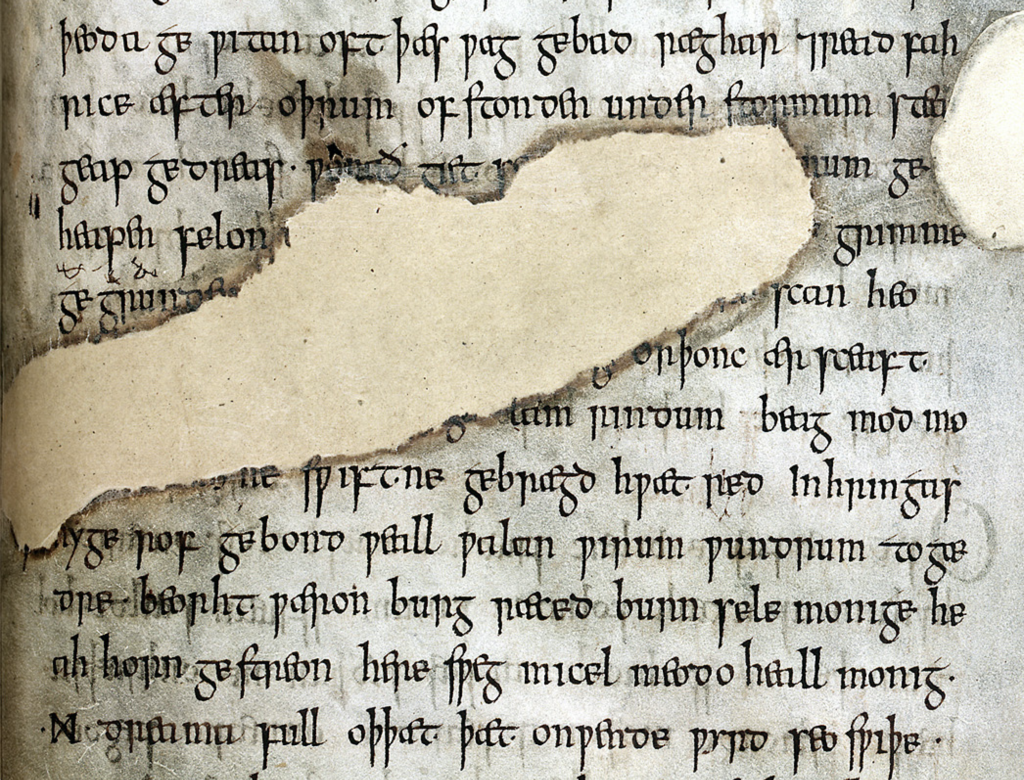
Today, however, I intend to solve this issue. I shall work closely with Dr. Aaron K. Hostetter translation of the poem to produce a version in which I will fill in the gaps created by the damage. This is primarily and imaginative exercise, and will rely heavily on my own speculation. But I hope that this exercise will prove fruitful by allowing me to fully immerse myself in the poem and understand its message. I also hope that perhaps my interpretive work on the poem will prove helpful in understanding the poem in its totality. I was inspired to take this on from an exercise we underwent in a recent class in which we were to gather a variety of translations of an old English poem of our choosing. I decided to work on The Ruin which peaked my curiosity as to what would be found if the damage could be repaired. So without further ado, my imaginative translation of The Ruin.
*Dr. Hostetter’s work will appear as normal text. My speculative inserts shall be coloured in red*
The Ruin
These wall-stones are wondrous —
calamities crumpled them, these city-sites crashed, the work of giants
corrupted. The roofs have rushed to earth, towers in ruins.
Ice at the joints has unroofed the barred-gates, sheared
the scarred storm-walls have disappeared—
the years have gnawed them from beneath. A grave-grip holds
the master-crafters, decrepit and departed, in the ground’s harsh
grasp, until one hundred generations of human-nations have
trod past. Subsequently this wall, lichen-grey and rust-stained,
often experiencing one kingdom after another,
standing still under storms, high and wide—
it failed—
The wine-halls moulder still, hewn as if by weapons,
penetrated by the workings of time savagely pulverized by the hands of the world fires shined no more within these walls and so now adroit ancient edifice returns to the dust now a shadow bowed with crusted-mud —
The strong-purposed mind was urged to a keen-minded desire
in concentric circles; the stout-hearted bound
wall-roots wondrously together with wire. The halls of the city
once were bright: there were many bath-houses,
a lofty treasury of peaked roofs, many troop-roads, many mead-halls
filled with human-joys until that terrible chance changed all that.
Days of misfortune arrived—blows fell broadly—
death seized all those sword-stout men—their idol-fanes were laid waste —
the city-steads perished. Their maintaining multitudes fell to the earth.
For that the houses of red vaulting have drearied and shed their tiles,
these roofs of ringed wood. This place has sunk into ruin, been broken
into heaps,
There once many men, glad-minded and gold-bright,
adorned in gleaming, proud and wine-flushed, shone in war-tackle;
There one could look upon treasure, upon silver, upon ornate jewelry,
upon prosperity, upon possession, upon precious stones,
upon the illustrious city of the broad realm.
Stone houses standing here, where a hot stream was cast
in a wide welling; a wall enfolding everything in its bright bosom,
where there were baths, heated at its heart. That was convenient,
when they let pour forth the waters of youth over the hoary stones
countless heated streams from heights that trickle down until the ringed pool
hot to the skin, clear to ones soul and calm to the mind where there were baths
Then is the warrior set to lay his weary body. That is a kingly thing—
a house hidden away,
a city