I was recently re-reading The Horse and his Boy by C. S. Lewis and have had a few thoughts I felt might be worth jotting down. I have always been fascinated by The Chronicles of Narnia series. These were my favorite books as a child and truth be told, still among my favorites today. The Horse and his Boy is a particularly special book to me. It was certainly one of my favorites from the series, and I have heard many people who have read the entirety of the collection say it is their favorite. One of the many things that draws me back to the Narnia series as an adult is Lewis’ use of his expertise as a medievalist to inform his work. As a medievalist myself, and one who is interested in the modern reception of the themes and tropes of medieval literature, I have found the work of Lewis to be somewhat of a goldmine. However, The Horse and his Boy never struck me as a work particularly linked with the medieval. As an adult reader, I always found the work to be a reflection of Lewis’ journey back to faith, as the plot centers around a young slave boy’s return to his own country, where he discovers himself to be royalty, and the role Alsan, the figure who in Lewis’ work represents God, plays in the development of this journey.
“I was the lion who forced you to join with Aravis. I was the cat who comforted you among the houses of the dead. I was the lion who drove the jackals from you while you slept. I was the lion who gave the horses the new strength of fear for the last mile so that you should reach King Lune in time. And I was the lion you do not remember who pushed the boat in which you lay, a child near death, so that it came to shore where a man sat, wakeful at midnight, to receive you” (Lewis, 281).
Indeed, the central theme of this book is inspired by the idea of a return journey to faith, which is represented in the journey of Shasta’s return home. However, my recent re-reading opened my eyes to sources that Lewis must have drawn from in writing this novel. So, for this blog entry, I would like to take you on a journey, through the wardrobe and into Narnia, where we will discover the medieval sources for The Horse and his Boy.
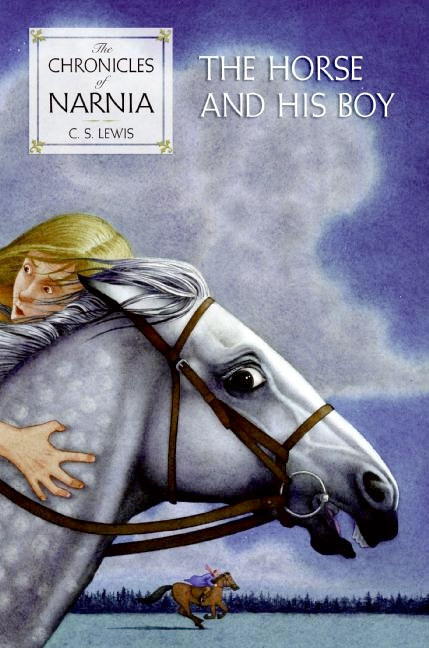
Cover art for The Horse and his Boy
I found myself in an entirely new context as I read this book once again. I was at home reading aloud in the kitchen while my dinner was being prepared for me by my fiancé. My fiancé, Rachel, is like myself, a student of English literature, but while I opted to study History alongside English, she went down the route of Celtic Civilization. My own knowledge of Celtic studies would not be so strong, but this is not the case for her, as she has become fascinated with it since undertaking it as a subject. It was her observations that lead my down a road of research which has become the content of this blog today.
The first area of interest which would be illuminated to me would be that of the geography of Lewis’ mythical world surrounding the land of Narnia. The Horse and his Boy is a unique book within the series as while it details a journey into Narnia, as is the case with the other books of the series, this is to be the first book which does not employ the use of interdimensional travel from our world to Narnia, rather, it narrates their journey of characters from one of the neighbouring lands into Narnia. It is therefore logical that this book should be far more interested with the geography of the Lewis’ mythical world than any of the others (with perhaps the exception of The Voyage of the Dawn Treader concerned with the oceanography of the world). The first insight the reader is given into the geography of this world is that of the true identity of the main character, Shasta, who finds out through overhearing a conversation between his supposed father and a nobleman that he is form the North of this world “like the accursed but beautiful barbarians who inhabit the remote North” (Lewis, 207). It was this line in particular which Rachel found to be of interest, who pointed out that this quite interestingly mirrors the anthropology of our own world. The Celts were a collection of peoples who inhabited lands to the North of the Mediterranean region. And these peoples were seen by the Greek and Roman cultures to be “barbarians.”
It was of interest to her that the Lewis would be concerned with the “barbarians” of his imaginative world in this book, in which a young boy would be taken on a journey to another land. This is indeed a trope of Celtic storytelling, consider for example, the story of Oisín in Tír na nÓg. In this tale the protagonist, Oisín is brought to the land of the young (Tír na nÓg) to marry the princess of this land, Niamh. It is an intriguing fact that the land of Narnia is also, to some extent, a land for the young. Lewis’ books are told from the perspective of children who find their way into Narnia through various portals (wardrobes, paintings and train stations for example). This theme relates nicely to the Celtic “otherworld” trope in which characters find their way into alternate worlds through seemingly ordinary, everyday means – consider texts such as Sir Orfeo and Thomas of Erceldoune. As well as this, Narnia is a world in which the children who enter, though they may age in the world of Narnia, will remain the same age in the “real world” as is revealed in the ending of The Lion, the Witch and the Wardrobe. In other words, time works strangely in Narnia, and this is also true of the Celtic otherworld.
It has been of great interest to me to learn of the unique connection between Lewis’ imaginative works and Celtic folklore, and has certainly enriched my reading of both Lewis and medieval texts. This is an area which I certainly look forward to researching in the future.